
Best AI Model for Creative Writing: How to Choose the Right One for Your Stories
The number of AI writing tools has exploded. Dozens of platforms promise to help you write better stories, faster. But most writers trying them for the first time walk away frustrated — not because AI can't write, but because they picked the wrong tool for their needs.
Finding the best AI model for creative writing isn't about chasing the most powerful language model. It's about finding the right fit for how you write, what you write, and how much creative freedom you actually need.
This guide breaks down what separates good creative AI tools from great ones — so you can make a confident choice without wading through marketing fluff.
What Actually Matters When Evaluating AI Creative Writing Tools
Most comparison articles rank tools by "output quality" as if that's a single measurable thing. It isn't. Here's what to actually evaluate:
1. Narrative Coherence Over Long Form
Short-burst generation is easy. Maintaining story logic, character voice, and plot consistency across thousands of words is hard. Many models drift — characters change personality, timelines break, earlier plot points vanish. Look for tools that handle story memory well.
2. Genre and Tone Flexibility
A horror story and a cozy romance require completely different registers. Tools that default to one neutral "creative" mode often produce flat, generic prose. The best tools let you specify genre, tone, and style — and actually honour those inputs throughout the piece.
3. Creative Freedom vs. Content Restrictions
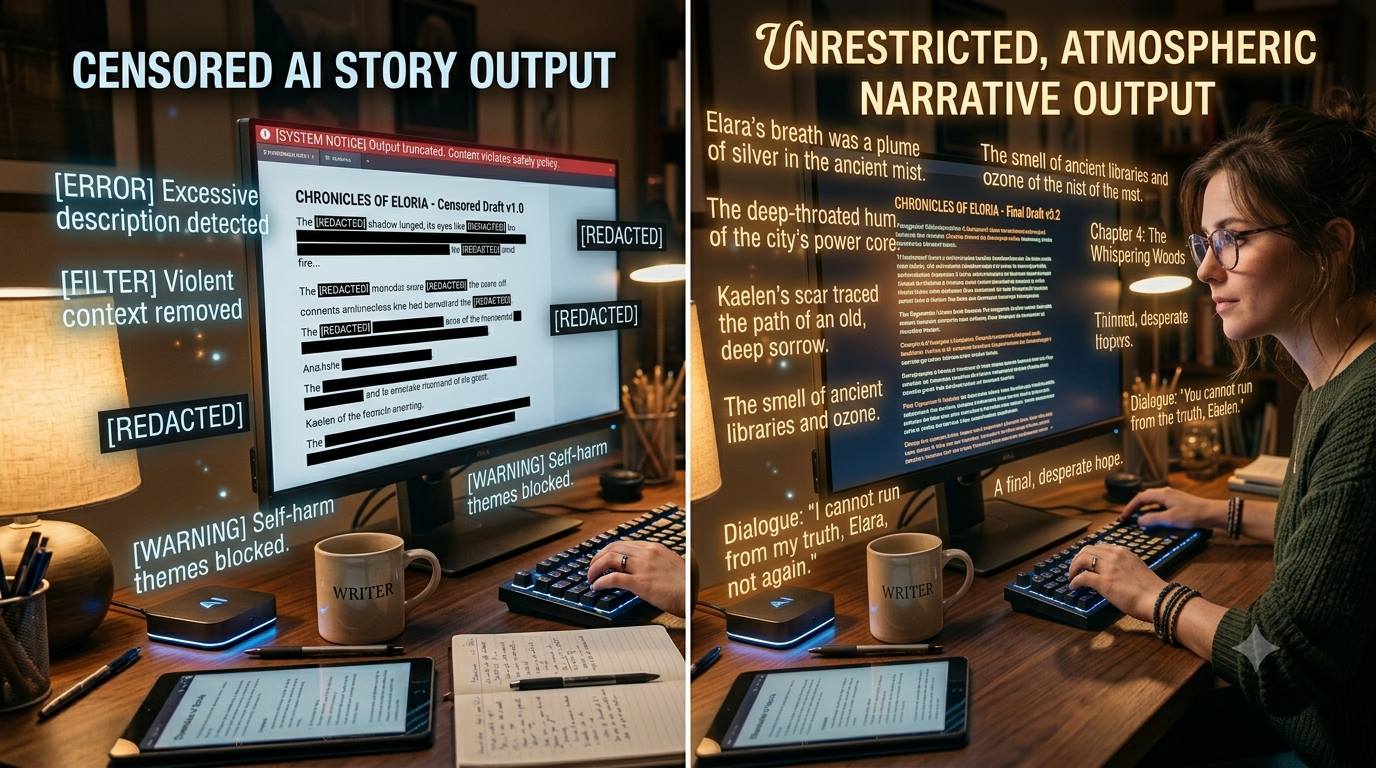
Many general-purpose AI tools apply broad content filters built for business use. These filters frequently interrupt creative fiction — blocking dark themes, morally complex villains, or mature emotional tension that serious storytelling requires. Industry estimates suggest over 60% of creative writers report hitting content restrictions when using general AI assistants for fiction.
4. Collaborative Control vs. Full Automation
Do you want to steer, or do you want the AI to drive? Some writers want to co-author, feeding ideas and shaping output. Others want to hit a button and read a finished story. The ideal tool depends on your workflow, not on which model scores highest on a benchmark.
5. Export, Sharing, and Format Options
If you're serious about your output — publishing, sharing, or archiving — you need tools that export cleanly. EPUB and PDF export matter for authors. Easy sharing matters for content creators posting stories online.
How Popular AI Approaches Compare for Creative Fiction
| Approach | Best For | Limitations | Creative Freedom |
|---|---|---|---|
| General LLMs (e.g. ChatGPT, Claude) | Drafting scenes, brainstorming ideas | Content filters, no story continuity features, not built for narrative flow | Moderate — varies by prompt |
| Writing assistants (e.g. Sudowrite) | Authors who want editorial AI support | Expensive, steep learning curve, built for polished authors not hobbyists | High — designed for fiction |
| Roleplay/character AI platforms | Dialogue and character interaction | Weak narrative structure, not built for complete stories | Variable — often filtered |
| Dedicated story generation platforms | Casual to serious writers wanting full narratives | Less editorial control in some tools | High — purpose-built for fiction |
The pattern is consistent: general AI tools are versatile but not optimised for story. Specialist fiction tools trade breadth for depth — and for creative writing, that trade is usually worth it.
The Hidden Problem: Creative Restrictions That Stall Good Stories
Here's a scenario most writers know well. You're building toward a tense, emotionally charged scene. You ask the AI to continue. It refuses, softens the content, or rewrites your villain into something toothless. The story loses its edge.
This happens because most AI models are trained with broad safety layers never designed with literary fiction in mind. According to a 2023 survey by The Creative Independent, 71% of writers using AI tools reported that restrictive outputs were their biggest frustration — above price and above quality.
Great fiction has always explored difficult terrain. Censorship-by-default isn't a creative writing feature — it's a limitation dressed up as responsibility.
What to Look for in a Dedicated Creative Writing AI
Once you move beyond general LLMs, the evaluation criteria sharpen. Here's a practical checklist:
- Genre and tone controls — Can you set the mood before generating, or are you stuck editing after?
- Story continuation — Can the tool pick up where you left off without losing context?
- Dynamic plot tools — Does it help you break out of predictable story arcs?
- Narrative style options — First person, third person, literary, pulp — can you choose?
- Uncensored output for mature themes — Can it handle the full emotional and dramatic range of fiction?
- Export options — Does your story live only on-platform, or can you take it with you?
Tools like Freequill are built specifically around these needs. Rather than bolting story features onto a general assistant, the entire platform is designed around narrative — with genre and tone selection built in from the first prompt, not as an afterthought.
A hobbyist writer using Freequill, for example, can set a dark psychological thriller tone, generate an opening chapter, then use the Continue Story feature to extend it scene by scene — without the AI forgetting earlier details or softening the tension halfway through.
Honest Pros and Cons: What AI Still Can't Do
Even the best AI model for creative writing has real limits. Being honest about them helps you use these tools better.
Where AI Genuinely Helps
- Breaking through blank page paralysis
- Generating volume quickly for experimentation
- Exploring genres or styles you're unfamiliar with
- Producing consistent output when you're low on energy
- Generating plot variations and unexpected story directions
Where AI Still Falls Short
- Deeply personal voice — your specific prose rhythm is hard to replicate
- True novelty — AI recombines patterns; it doesn't invent from nothing
- Long-form coherence — even good tools need human oversight over 10,000+ words
- Emotional authenticity — AI can describe emotion; it can't feel it
The writers who get the most value from these tools treat AI as a creative collaborator, not a ghostwriter. You bring the intent, the taste, and the editorial eye. The AI brings speed and range.
Price Range: What Does Quality Creative AI Cost?
Pricing varies widely across tools:
- Free tiers — Limited generation, often watermarked or restricted. Good for testing.
- $10–$20/month — Entry-level paid plans. Sufficient for casual daily use.
- $25–$50/month — Mid-range plans with export features, longer generation, and fewer restrictions.
- $100+/month — Professional tools aimed at published authors or agencies. Often overkill for casual writers.
Freequill offers a free entry point with paid plans that unlock features like EPUB/PDF export, the Plot Twist Engine for dynamic storytelling, and the full narrative style selector — making it accessible whether you're a hobbyist experimenting daily or a more serious writer building complete stories.
[IMAGE: A writer reading a completed AI-generated story on a tablet, with genre tags and tone settings visible on screen]Which Writers Should Choose a Dedicated Story Platform?
If you primarily use AI for emails, summaries, or research — a general LLM is fine. But if your goal is fiction, the answer shifts.
A dedicated platform makes more sense if you:
- Write fiction regularly, even just for fun
- Care about genre, voice, and narrative atmosphere
- Have hit creative walls with general AI tools
- Want to share or publish your output
- Need uncensored creative range for compelling storytelling
Creative writing students experimenting across genres, content creators building shareable fiction series, and hobbyist writers who simply love making stories — these are exactly the people purpose-built platforms serve best.
Making Your Choice
The best AI model for creative writing is the one that gets out of your way creatively while giving you enough structure to actually finish something. That balance — freedom plus form — is what separates a useful tool from a frustrating one.
General AI models are impressive. But for fiction, the restrictions, the lack of narrative memory, and the absence of story-specific controls add friction at every turn. Purpose-built platforms remove that friction by design.
If you're ready to explore what AI-assisted storytelling actually feels like when it's built for writers — not repurposed from a business tool — start writing for free now and see how far your stories can go.
Try it yourself — generate a story now
Fantasy, romance, horror, sci-fi — any genre, any tone. Start free, no credit card.
Generate a Story →