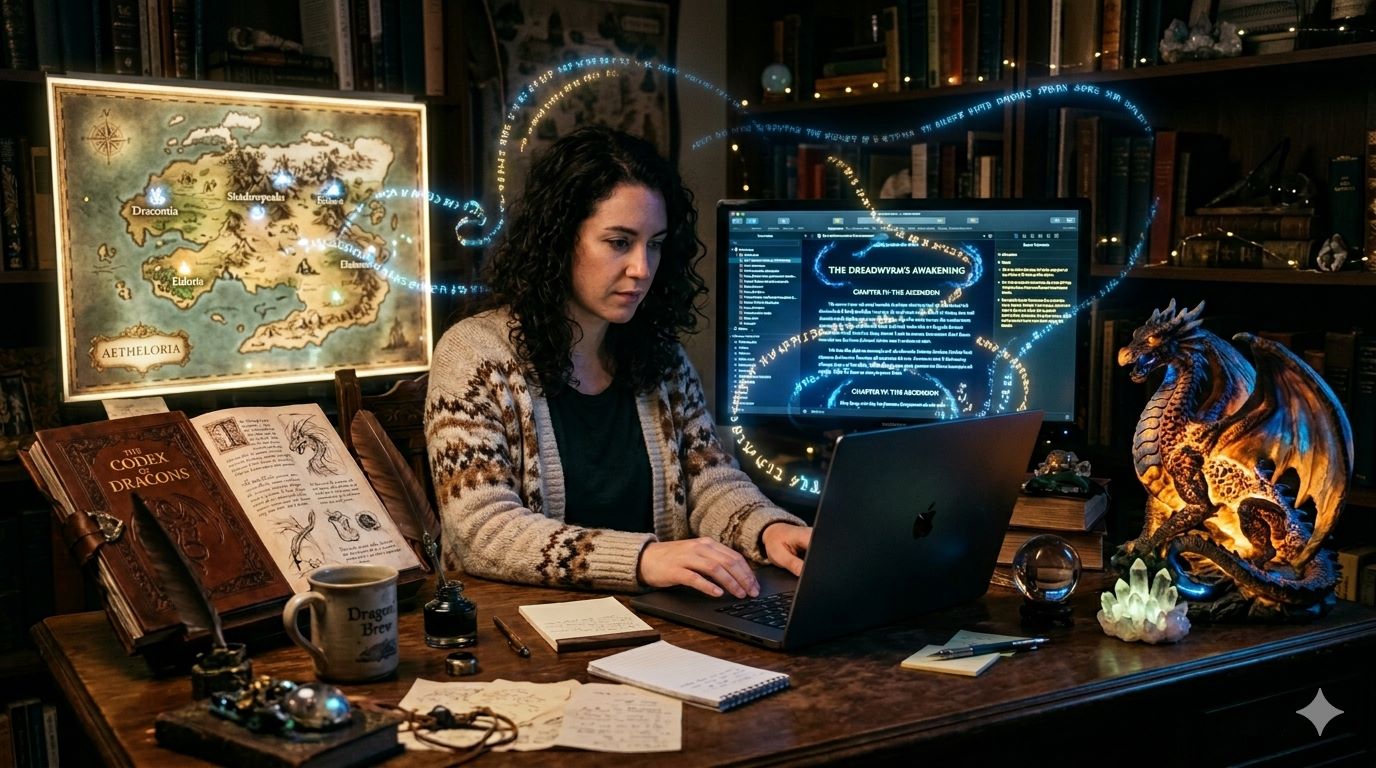
Fantasy Writing Prompt Generator: How to Use One (and Get the Most Out of It)
Every fantasy writer knows the feeling. You sit down to write, and the blank page just stares back. You have a vague idea — maybe a world, maybe a character — but you can't find the door in.
That's exactly what a fantasy writing prompt generator is built to solve. It gives you a starting point. Sometimes that's all you need.
But not all prompt tools are created equal. Some spit out generic one-liners. Others give you rich, story-ready scenarios that actually spark something. Knowing the difference — and knowing how to use these tools well — can completely change your writing practice.
What Is a Fantasy Writing Prompt Generator?
At its core, a fantasy writing prompt generator is a tool — usually AI-powered — that produces creative writing prompts set in fantastical or speculative worlds. These prompts might describe a character, a conflict, a setting, or an entire opening scenario.
The best ones go further. They allow you to customize genre (epic fantasy, dark fantasy, portal fantasy), tone (gritty, whimsical, mythological), and even narrative perspective. That level of control makes the difference between a forgettable prompt and one that opens up a whole story world.
According to a 2023 survey by the National Novel Writing Month (NaNoWriMo) community, over 60% of participants said they struggled with story beginnings more than any other part of the writing process. Prompt generators directly address that gap.
Why Fantasy Writers Specifically Benefit
Fantasy is a broad genre. It spans cozy cottagecore magic to brutal grimdark warfare. That breadth is exciting — but it can also be paralyzing.
A good fantasy story prompt tool helps you commit to a direction. Instead of staring at infinite possibilities, you get a concrete scenario: a disgraced knight, a map to a city that shouldn't exist, and a deadline written in blood. Now you have something to push against.
Fantasy also relies heavily on world-building. Prompts that include setting details — not just character beats — are far more useful for this genre. They give you a piece of the world to build outward from.
How to Use a Fantasy Prompt Generator Effectively
Getting value from a prompt generator isn't just about clicking "generate." Here's how to use one with intention.
1. Use it as a launch pad, not a script
The prompt is not your story. It's a door. Step through it, then decide where you're going. Don't feel obligated to follow the prompt literally — take the element that sparks something and run with it.
2. Customize your inputs
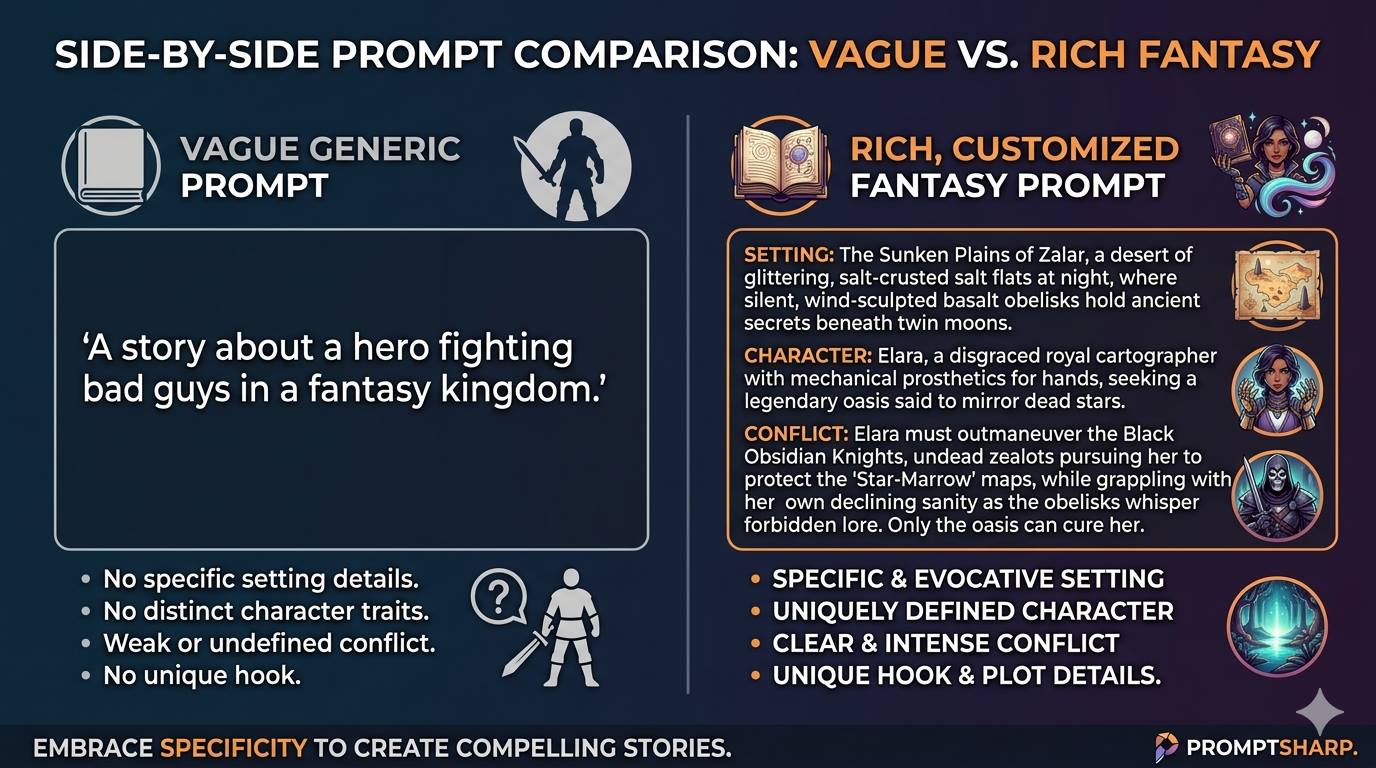
If your generator allows it, specify tone and sub-genre before generating. "Epic fantasy with a hopeful tone" will give you very different material than "dark fantasy with a cynical narrator." Targeted inputs produce more usable results.
3. Generate in batches
Don't stop at the first prompt. Generate five or ten, then pick the one that genuinely excites you. That gut reaction — the slight pull toward one idea — is worth following.
4. Combine prompts
Two mediocre prompts can become one great story concept. Take the setting from one and the character conflict from another. This forces creative synthesis and often produces something more original.
5. Continue the story, don't just start it
Many writers use prompts to get started but then stall again at chapter two. The best AI writing tools let you continue a story from where you left off — keeping tone, voice, and plot threads intact.
Common Mistakes Writers Make with Prompt Generators
Even experienced writers fall into a few traps when using these tools. Here's what to watch out for.
Taking every output at face value
AI-generated prompts are starting points, not finished ideas. If something feels clichéd — the chosen one, the evil dark lord — treat it as raw material to subvert, not a template to follow.
Skipping customization
Generic inputs give generic outputs. If your tool offers genre, tone, or character settings, use them. A fantasy writing idea generator with no customization produces the same few tropes on a loop.
Using prompts as a crutch
Prompts are for ignition, not sustained fuel. Build a habit of developing your own ideas alongside using generators. Over time, you'll find you need the tool less — and use it smarter when you do.
Abandoning good prompts too soon
A prompt that doesn't immediately excite you might be one of your best stories in disguise. Sit with it. Write the first paragraph. See what happens. Industry estimates suggest that writers who push past initial resistance often find their strongest material there.
What to Look for in a Good Fantasy Prompt Generator
Not every tool deserves your time. Here's what actually matters.
- Genre specificity — Can it go beyond "fantasy" to dark fantasy, portal fantasy, or sword-and-sorcery?
- Tone control — Can you set the emotional register before generating?
- Story continuation — Can you feed it what you've written and keep going?
- Output quality — Does it produce coherent, story-ready scenarios rather than disconnected sentence fragments?
- Creative freedom — Does it sanitize everything into safe, predictable territory, or can it handle morally complex, dark, or unconventional narratives?
That last point matters more than most writers realize. Fantasy often requires moral ambiguity, violence, and difficult themes. A tool that filters all of that out becomes useless for serious world-building.
A Tool Worth Knowing: Freequill
For writers who want more than a one-line prompt, Freequill offers a genuinely useful alternative. It's an AI-powered creative writing platform that lets you set genre and tone before generating — so what comes out is shaped to your vision, not a generic default.
What makes it stand out for fantasy writers specifically is the combination of features working together. The Continue Story feature lets you pick up exactly where you left off, maintaining consistency in tone and plot. The Plot Twist Engine introduces unexpected story turns — the kind that feel earned rather than random. And critically, Freequill operates without content restrictions, which means dark themes, complex villains, and morally gray scenarios are all on the table.
Take a hobbyist writer who generates a short fantasy story each morning before work — just for fun, with no publication goal. With a narrative style selector and genre settings, they can shift from writing lyrical high fantasy one day to punchy dark fiction the next, without losing momentum or having to manually reset the tool's defaults.
If you want a fantasy writing prompt generator that actually builds into a full writing environment, it's worth exploring. You can start writing for free now and see how far a single prompt takes you.
Frequently Asked Questions
Are fantasy writing prompt generators good for beginners?
Yes — especially for beginners who feel intimidated by the blank page. A prompt removes the pressure of coming up with everything yourself. You just need to respond to what's in front of you.
Can I use AI-generated prompts for published work?
You can use a prompt as inspiration without issue. If you're building an entire story using AI-generated content, check the terms of the platform you're using and any relevant publishing guidelines. Most hobbyist and personal use cases have no restrictions.
How often should I use a prompt generator?
As often as it helps. Some writers use one daily as a warm-up exercise. Others reach for it only when stuck. There's no right frequency — only what keeps you writing.
What's the difference between a prompt generator and a full AI story generator?
A prompt generator gives you a starting idea. A full AI story generator — like Freequill — takes that further by actually writing, continuing, and shaping the narrative based on your inputs. One sparks the fire; the other helps you sustain it.
Do fantasy prompt generators work for all sub-genres?
The better ones do. Tools with sub-genre customization can handle epic fantasy, urban fantasy, dark fantasy, fairy tale retellings, and more. Tools without that control tend to default to the same high-fantasy tropes repeatedly.
The right fantasy writing prompt generator won't write your story for you — but it will get you past the part where most writers quit: the beginning. Pair it with a tool that lets you keep going, and the blank page stops being the enemy.
If you're ready to stop staring and start writing, start writing for free now and see where your first prompt leads.
Try it yourself — generate a story now
Fantasy, romance, horror, sci-fi — any genre, any tone. Start free, no credit card.
Generate a Story →