
QuillBot AI Story Generator: What It Does, What It Lacks, and What Writers Actually Need
If you've searched for a QuillBot AI story generator, you're probably looking for a way to generate creative stories using AI — fast, with minimal friction, and with enough flexibility to match your voice.
That's a fair goal. AI writing tools have exploded in the past two years. According to a 2023 survey by the Authors Guild, nearly 20% of writers have experimented with AI tools for drafting or brainstorming. The category is no longer niche — it's mainstream.
But before you commit to any platform, it helps to understand what you're actually getting. This guide breaks down how QuillBot handles story generation, where it genuinely helps, and where dedicated story tools do the job better.
What Is QuillBot — And What Does It Actually Do?
QuillBot is primarily a paraphrasing and grammar tool. It rewrites existing text to improve clarity, change tone, or reduce plagiarism. It's popular with students, academics, and professionals who need to polish written content.
Over time, QuillBot added more features: a summarizer, a citation generator, a co-writer mode, and basic AI writing assistance. Some of these tools can help generate short passages of text — which is likely why writers search for a QuillBot AI story generator in the first place.
But here's the honest picture: QuillBot was not built for storytelling. It's a broad writing utility. Generating a gripping short story, extending a narrative mid-scene, or injecting a plot twist on demand — these are not its strengths.
Where QuillBot Falls Short for Story Writers
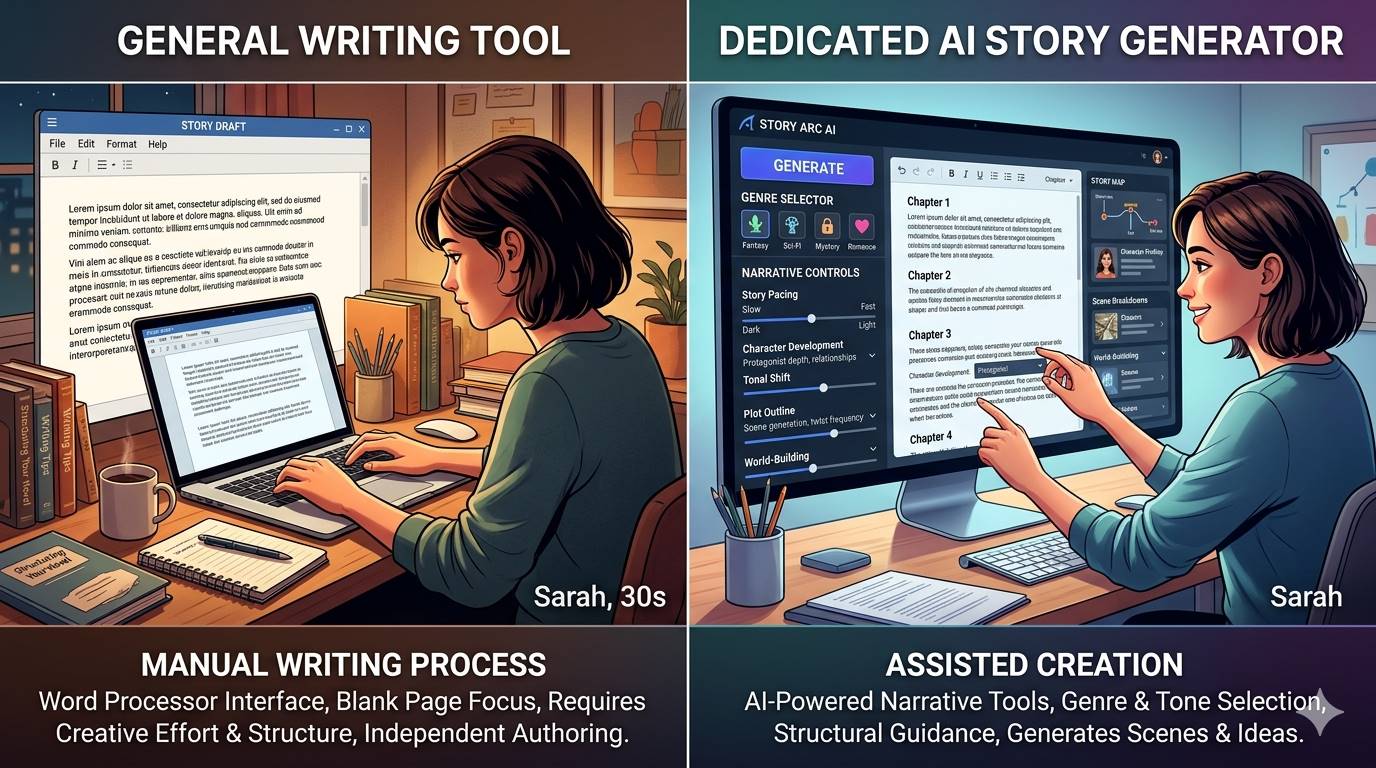
Trying to use a general writing assistant for creative fiction is a bit like using a Swiss army knife to carve a sculpture. It can make cuts, but it's not the right tool.
Specifically, QuillBot lacks:
- Genre and tone customization — you can't tell it "write this as gothic horror with a melancholic narrator"
- Story continuation tools — there's no native feature to pick up where a narrative left off
- Plot development support — no engine for adding twists, raising stakes, or resolving subplots
- Unrestricted creative output — broad-purpose tools often apply aggressive content filters that interrupt creative fiction
For a hobbyist who wants to generate short fiction daily, or a student experimenting with dark fantasy and psychological thrillers, these gaps matter a lot.
Cost matters too. QuillBot's paid tier starts at $13 per month — and that's for a tool that treats story generation as a side feature, not a core offering.
What a Dedicated AI Story Generator Should Offer
If creative writing is your goal — even just for fun — you need a tool built around that specific purpose. Here's what separates a real story generator from a general writing assistant.
1. Genre and Tone Selection
Good story generation starts with context. A tool should let you choose your genre (romance, sci-fi, thriller, horror, fantasy) and your narrative tone (dark, humorous, suspenseful, lyrical) before generating a single word. This shapes everything — vocabulary, pacing, sentence rhythm, character voice.
2. Story Continuation
Most stories don't happen in one session. You need the ability to pause, return, and extend a narrative without losing its thread. A Continue Story feature that understands what's already been written is essential for any serious creative workflow.
3. Dynamic Plot Tools
Flat narratives lose readers fast. A dedicated story generator should help you introduce tension, surprise, and momentum — not just produce grammatically correct prose. Tools like a Plot Twist Engine exist precisely for this: keeping stories alive past the first few paragraphs.
4. Freedom to Write Without Guardrails
Literary fiction explores dark, complex, and morally ambiguous territory. A tool that sanitizes every output isn't useful for a writer working in horror, crime, or psychological drama. Unrestricted generation — within the bounds of responsible use — is a genuine necessity for many writers.
A Real Example: From Prompt to Story
Consider Maya, a creative writing student experimenting with dystopian fiction. She starts with a simple premise: a society where memories are auctioned. She selects a dark sci-fi tone and a third-person limited narrative style. Within seconds, she has a 600-word opening scene. She hits "Continue Story," adds a plot twist midway through act two, and finishes a draft in under an hour — ready to share on her writing blog.
That kind of workflow isn't possible with a general paraphrasing tool. It requires a platform built specifically around narrative creation.
Freequill: A Focused Alternative Worth Knowing
Services like Freequill solve this by building every feature around the story — not around grammar correction or academic writing. Genre selection, tone control, a narrative style selector, and a Plot Twist Engine are all native to the platform. You're not retrofitting a utility tool; you're working in an environment designed for fiction from the ground up.
For writers who want to explore different styles without hitting creative walls, Freequill's uncensored approach means the story goes where it needs to go. There's no frustrating output that gets cut off because a scene is "too dark" for a general-purpose tool.
Pricing is also a legitimate consideration. At $9 per month, Freequill's subscription is meaningfully cheaper than QuillBot's paid plan — and it's purpose-built for what you're actually trying to do. You can review all available pricing plans before committing to anything.
Common Mistakes Writers Make When Choosing an AI Story Tool
Before picking any platform, it's worth avoiding a few traps that catch a lot of writers off guard.
Choosing breadth over depth
A tool that does "everything" often does nothing particularly well. If storytelling is your focus, a specialist tool almost always outperforms a generalist one.
Ignoring output control
Not all AI generators let you shape the output after the first draft. Look for platforms where you can steer tone, extend scenes, or redirect the plot — not just regenerate the same paragraph.
Underestimating content restrictions
Many writers discover too late that a tool won't generate the kind of morally complex or dark content their story requires. Test this early, before you've built a workflow around a platform.
Paying for features you don't need
Academic citation tools, plagiarism checkers, and grammar assistants are useful — but not if you just want to write fiction. Don't pay for a feature bundle built for students when you need a story engine.
Frequently Asked Questions
Can QuillBot write full stories?
QuillBot can generate short text passages using its co-writer mode, but it's not designed for full narrative generation. It lacks genre controls, story continuation, and plot development features that dedicated story tools offer.
Is there a free AI story generator I can try?
Yes. Several dedicated story generators offer free tiers or trials. Freequill, for example, allows you to start writing for free now without a credit card, so you can test the output quality before upgrading.
What's the difference between a paraphrasing tool and a story generator?
A paraphrasing tool rewrites existing content. A story generator creates original narrative from scratch — often with genre, tone, and character context built in. They solve completely different problems.
Are AI story generators good for beginners?
Absolutely. Industry estimates suggest that the majority of AI writing tool users are hobbyists and casual creators, not professionals. Tools with simple genre-and-tone selectors make it easy to start even with no writing experience.
Can I export stories I generate with AI tools?
It depends on the platform. Some tools offer export to EPUB or PDF, which is useful for writers who want to compile longer works. Check the platform's features page before signing up.
The Bottom Line
Searching for a QuillBot AI story generator usually means you want something QuillBot isn't quite built to deliver. It's a solid utility for editing and paraphrasing — but for generating, continuing, and shaping original fiction, it falls short.
If writing stories is the goal — whether for fun, for a portfolio, or just to see where a premise leads — use a tool designed around that. Freequill gives you genre control, narrative freedom, and story-specific features at a price that makes sense for casual and serious writers alike.
Ready to see what a real story generator feels like? Start writing for free now and generate your first story in under two minutes.
Try it yourself — generate a story now
Fantasy, romance, horror, sci-fi — any genre, any tone. Start free, no credit card.
Generate a Story →